Guide and free template
Interim payment certificate: what it is, how it is worked out, and a template
What an interim payment certificate is, what cumulative to date means, how its amount is worked out from the estimate and who signs it. At the end, a free template to fill in.
Template reviewed on November 23, 2026
What is an interim payment certificate?
It is the document that values the work carried out up to a date, using the estimate’s quantities and prices, so that the developer pays the contractor what that period is worth.
No authority sets a format for it. In public works contracts, the RGLCAP has the works management measure the work carried out every month and issue the certificate within ten days after the period it covers. On a private job, how often it is issued is whatever the contract says.
What is the difference between the period and cumulative to date?
Cumulative to date is all the work carried out from the start of the job to the certificate’s date. The period is the cumulative figure minus what the previous certificates already covered.
In public works contracts, the works management draws up a cumulative valuation every month and the contractor has ten working days to object; if it does not, it is deemed to agree. On a private job, the deadlines are whatever the contract says.
How is the amount of a certificate worked out?
For each item of the estimate, the work carried out to date is measured and multiplied by its unit price. The sum is the work carried out to date; take away the previous certificates and you have this one’s amount.
In public works contracts, the RGLCAP values the work at the project’s prices, adds the percentages the tender budget was built with and multiplies it by the award coefficient. On a private job, the contract decides. The items, their units and their prices come from the construction estimate.
What is retention on a certificate?
It is a part of the certified amount that the developer does not pay yet and keeps as security.
If there is retention, its percentage and when it is released are whatever the contract sets. This template leaves a line for it before the amount payable.
Who draws it up and who signs it?
In building, the Building Regulation Law (LOE) gives the director of works execution the job of drawing up and signing the interim certificates and the final account, and the works director that of endorsing them.
In public works contracts, the RGLCAP has the works management issue the certificate from the month’s valuation.
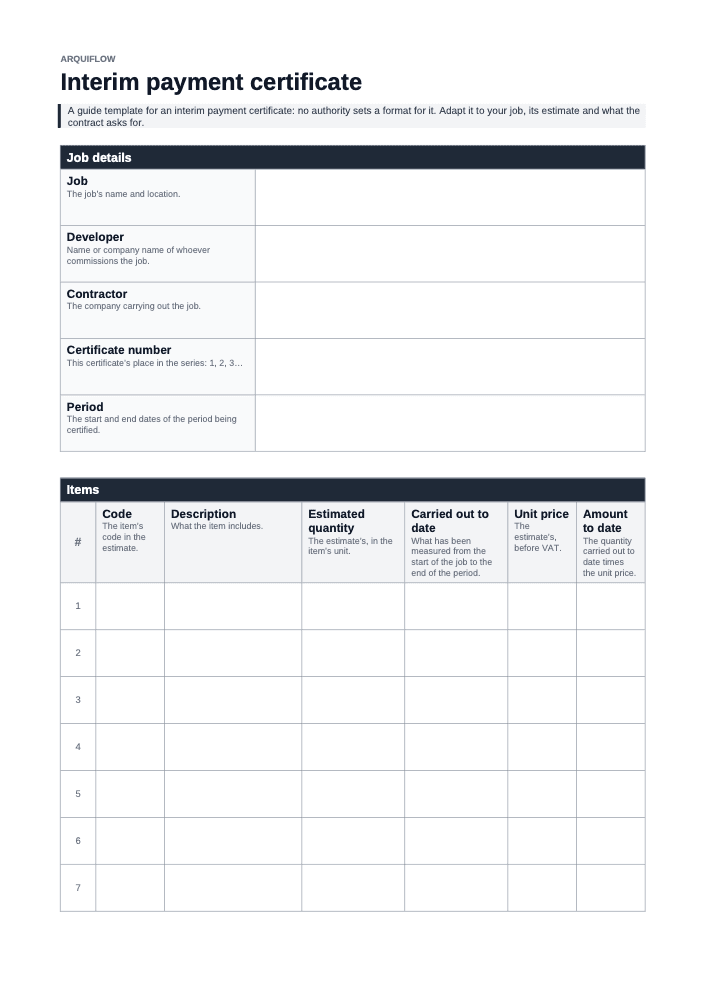
Interim payment certificate
A guide template for an interim payment certificate: no authority sets a format for it. Adapt it to your job, its estimate and what the contract asks for.
Job details
- Job
- The job’s name and location.
- Developer
- Name or company name of whoever commissions the job.
- Contractor
- The company carrying out the job.
- Certificate number
- This certificate’s place in the series: 1, 2, 3…
- Period
- The start and end dates of the period being certified.
Items
- Code
- The item’s code in the estimate.
- Description
- What the item includes.
- Estimated quantity
- The estimate’s, in the item’s unit.
- Carried out to date
- What has been measured from the start of the job to the end of the period.
- Unit price
- The estimate’s, before VAT.
- Amount to date
- The quantity carried out to date times the unit price.
Totals
- Work carried out to date
- The sum of the items’ amounts to date.
- Previous certificates
- What was certified up to the previous certificate.
- This certificate
- The work carried out to date minus the previous certificates.
- Retention
- If the contract provides for it, its percentage and amount.
- VAT
- The rate that applies to the job and its amount.
- Amount payable
- This certificate with VAT, less the retention.
Notes and signatures
- Notes
- New items, the contractor’s reservations or anything worth clarifying.
- Signatures
- The director of works execution, the works director and the contractor.
Who draws it up and who signs it
Before certifying, the site management team and the contractor check the quantities carried out in the period against each other. On a private job, the contract says how often it is certified, how it is paid and whether there is retention.
No authority sets a format for it. This template leaves room for three signatures: the director of works execution, who draws it up and signs it, the works director, who endorses it, and the contractor.
Get the editable Word version
We email you a link to download it and adapt it to your work.
Controller: ArquiFlow. Purpose: to send you the document and, only if you tick the box and confirm it from the email, ArquiFlow news. Legal basis: your request and, for the news, your consent. Recipients: our email provider. Rights: access, rectification, erasure and the others explained in the privacy policy.
Frequently asked questions
Is there an interim payment certificate format you have to follow?
No. No authority sets a format for it. This template lists the estimate’s items with the work carried out to date and then the totals, down to the amount payable.
Are interim certificates always monthly?
No. Monthly measurement is the RGLCAP’s, for public works contracts. On a private job, how often it is issued is whatever the contract agrees.
Why certify cumulatively and not just the period?
Because each certificate then covers all the work carried out to date, and the period’s amount comes from taking away what was already certified. A wrong earlier quantity is corrected in the next certificate without redoing the others.
ArquiFlow prepares the draft of your construction estimate
You describe the job and ArquiFlow prepares a draft estimate for you to review. Each price says where it comes from, and the studio’s own margin stays out of the PDF the client receives.