Guide and free template
Construction estimate template with measured quantities
What a construction estimate with measured quantities is, how it is arranged in chapters and items, and how you get from the material execution cost to the total. At the end, a free template to fill in.
Template reviewed on November 23, 2026
What is a construction estimate with measured quantities?
It is the document that prices a building job item by item: each item says what is done, the unit it is measured in, how many units there are (its measured quantity) and at what price, and its amount is the quantity times the unit price.
Spain’s Technical Building Code (CTE) lists the measurements and the budget among a project’s contents. A basic project only needs an approximate valuation of the material execution cost by chapters; the detailed budget carries a price table grouped by chapters and a summary by chapters stating the final execution and contract value.
What are chapters, items and unit prices?
Items are grouped into chapters by type of work: demolition, structure, masonry, building services… Each item has a code, a unit (m², m³, unit, kg…), a description, its measured quantity and its unit price.
In public works contracts, the RGLCAP builds each unit price from direct costs (labour, materials and machinery) and indirect costs, without VAT. On a private job, each company decides how it works out its prices.
How do you get from the material execution cost to the total?
The sum of the items, lump-sum items included, is the material execution cost. The usual practice is to add overheads and the contractor’s profit, and VAT at the end.
In public works contracts, the RGLCAP sets a range of 13 to 17 % for overheads, which each ministry fixes, and 6 % for the contractor’s profit. On a private job, the percentages are whatever the contract says.
What is the summary by chapters?
It is the table giving the amount of each chapter, so you can see at a glance how much each part of the job weighs in the total.
The CTE includes it in the project’s detailed budget, with the final execution and contract value. In this template it comes after the items and before the totals.
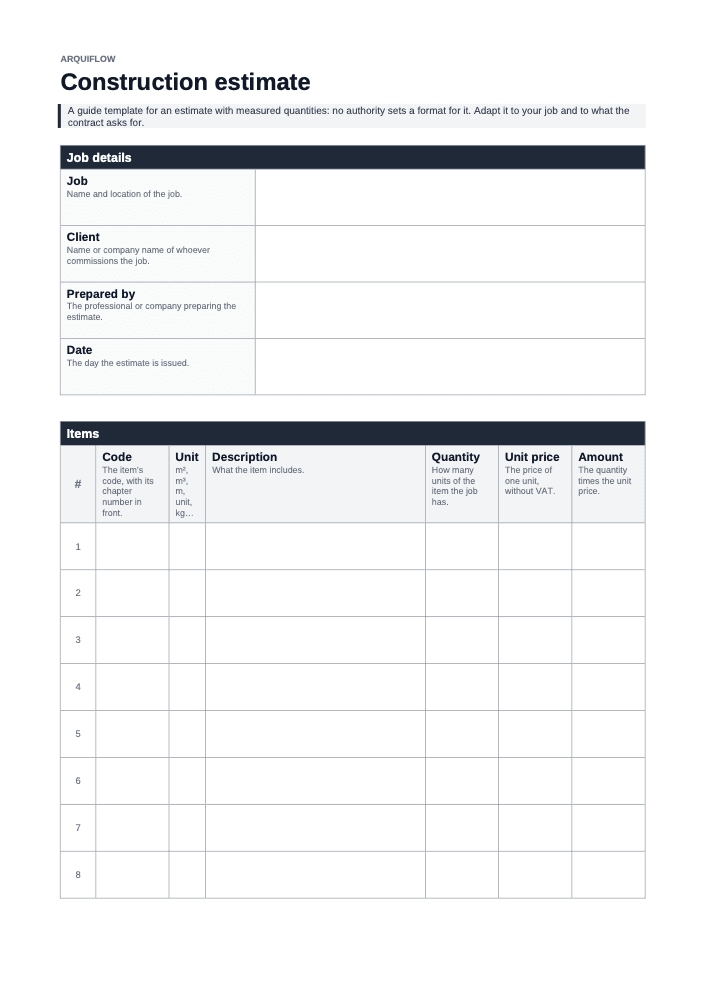
Construction estimate
A guide template for an estimate with measured quantities: no authority sets a format for it. Adapt it to your job and to what the contract asks for.
Job details
- Job
- Name and location of the job.
- Client
- Name or company name of whoever commissions the job.
- Prepared by
- The professional or company preparing the estimate.
- Date
- The day the estimate is issued.
Items
- Code
- The item’s code, with its chapter number in front.
- Unit
- m², m³, m, unit, kg…
- Description
- What the item includes.
- Quantity
- How many units of the item the job has.
- Unit price
- The price of one unit, without VAT.
- Amount
- The quantity times the unit price.
Summary by chapters
- Chapter
- Number and name of the chapter.
- Amount
- The sum of the chapter’s items.
Totals
- Material execution cost
- The sum of the chapters.
- Overheads
- The percentage the contract sets, and its amount.
- Contractor’s profit
- The percentage the contract sets, and its amount.
- Subtotal
- Material execution cost, overheads and contractor’s profit.
- VAT
- The rate that applies to the job, and its amount.
- Total
- The amount of the estimate including VAT.
Terms and signatures
- Validity and terms
- How long the estimate is valid, the payment terms and what it leaves out.
- Signatures
- Whoever prepares the estimate and, if they accept it, the client.
Who prepares it and who signs it
In a building project, the budget is part of the project and is prepared by whoever drafts the project. When a contractor bids for a job, it prepares its own estimate from the project’s measured quantities or from its own.
No authority sets a format for it. It is signed by whoever prepares it and, when they accept it, by the client; the contract decides. This template leaves room for three signatures.
Get the editable Word version
We email you a link to download it and adapt it to your work.
Controller: ArquiFlow. Purpose: to send you the document and, only if you tick the box and confirm it from the email, ArquiFlow news. Legal basis: your request and, for the news, your consent. Recipients: our email provider. Rights: access, rectification, erasure and the others explained in the privacy policy.
Frequently asked questions
Is there a construction estimate format you have to follow?
No. No authority sets a format for it. The CTE says what a project’s budget contains, a price table and a summary by chapters, and this template follows that order.
Are overheads always 13 to 17 % and the contractor’s profit 6 %?
No. Those percentages are the RGLCAP’s, for public works contracts. On a private job, the percentages are whatever the contract agrees.
What is the difference between the measured quantities and the estimate?
The measured quantities say how many units of each item the job has; the estimate multiplies each quantity by its unit price and adds the amounts up by chapter.
ArquiFlow prepares the draft of your construction estimate
You describe the job and ArquiFlow prepares a draft estimate for you to review. Each price says where it comes from, and the studio’s own margin stays out of the PDF the client receives.